OpenAI Prism
vs

SciSpace Agent
Prism vs SciSpace: Choosing
The Right Workspace for Research
With the launch of OpenAI's Prism, the research world gained a powerful LaTeX-native writing environment. Read on to learn how Prism compares to SciSpace, a vertically integrated "AI Co-Scientist" that automates discovery, data extraction, and evidence-backed synthesis.
What's an AI Research Workspace?
An AI Research Workspace is an integrated platform that helps researchers discover, understand, synthesize, and produce knowledge by combining AI reasoning with trusted sources and research workflows.
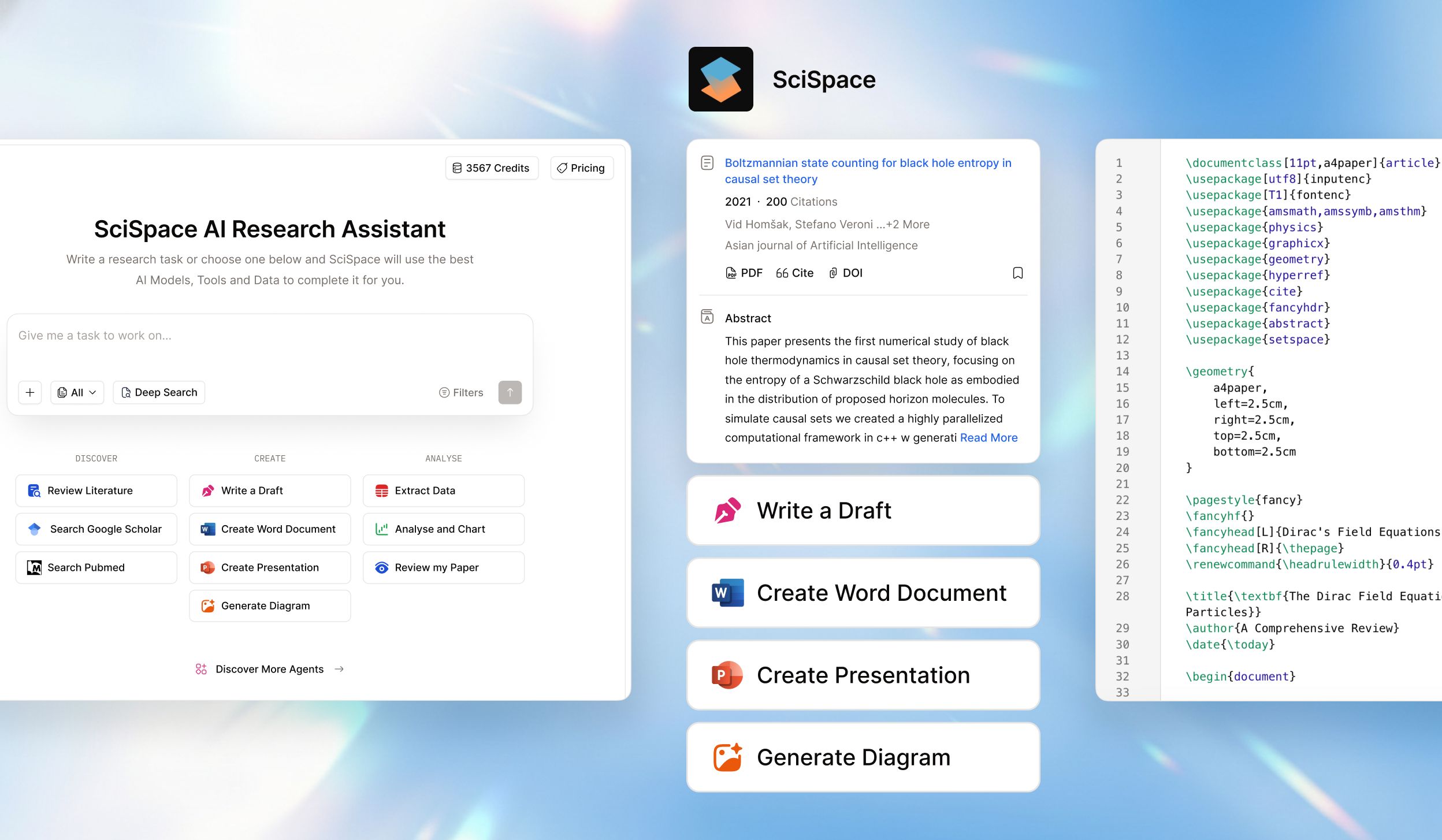
Discover, read, and synthesize papers without leaving the platform.
Get instant answers from papers, literature reviews, and more.
Turn your research into publication-ready documents seamlessly.
Compare Workspace Capabilities
of Prism vs SciSpace
Here's a breakdown of the workspace capabilities of Prism and SciSpace.
Prism
SciSpace
Create and Edit LaTeX Documents
Proofreading and Formatting
Find Citations from ArXiV and Web
Find Citations from Google Scholar, Pubmed
Search 300 Million+ Research Papers
Literature Review with CSV Export
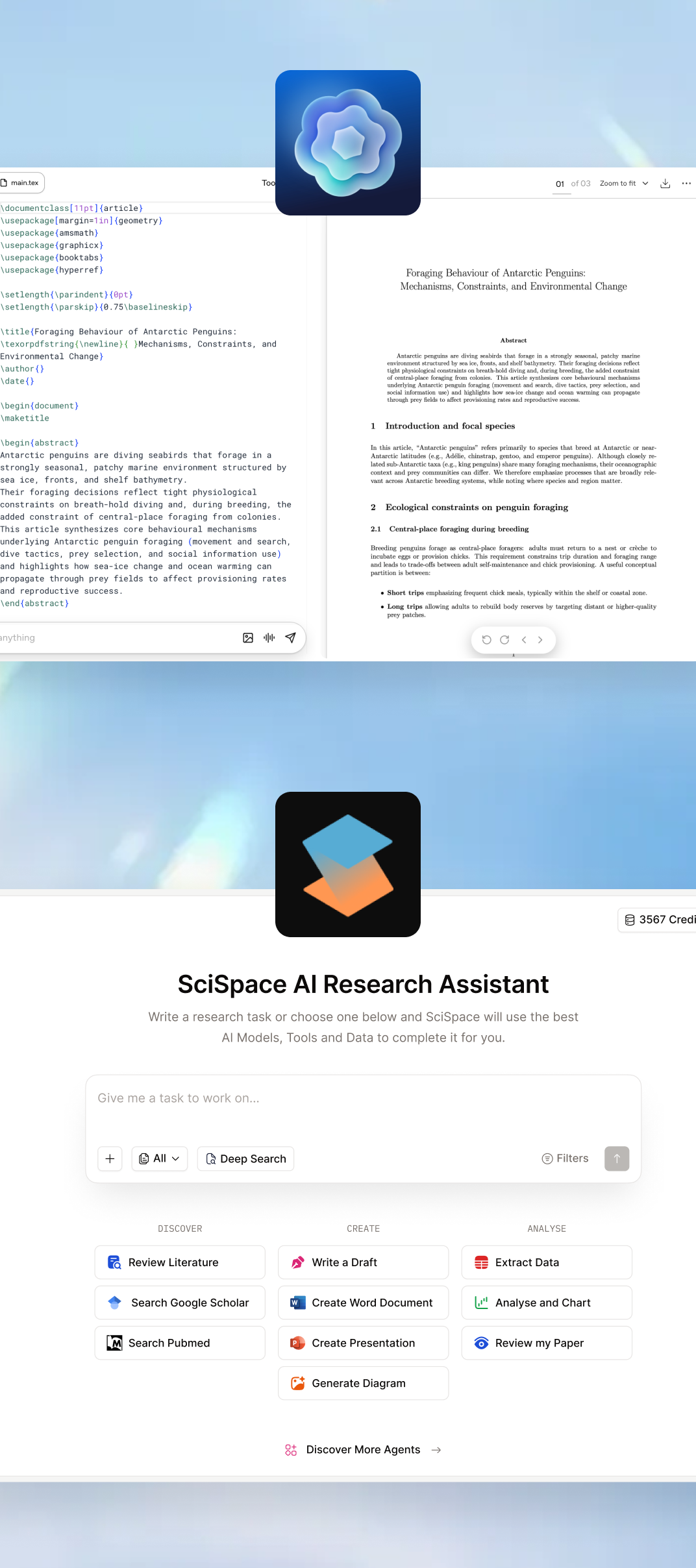
Convert or Create in Word and Powerpoint formats
Create LaTeX posters, presentations
Detect and remove AI Generated Content
What makes SciSpace the
Choice of 6 Million+ Researchers?
Here's what makes SciSpace the preferred research workspace for researchers and academics.

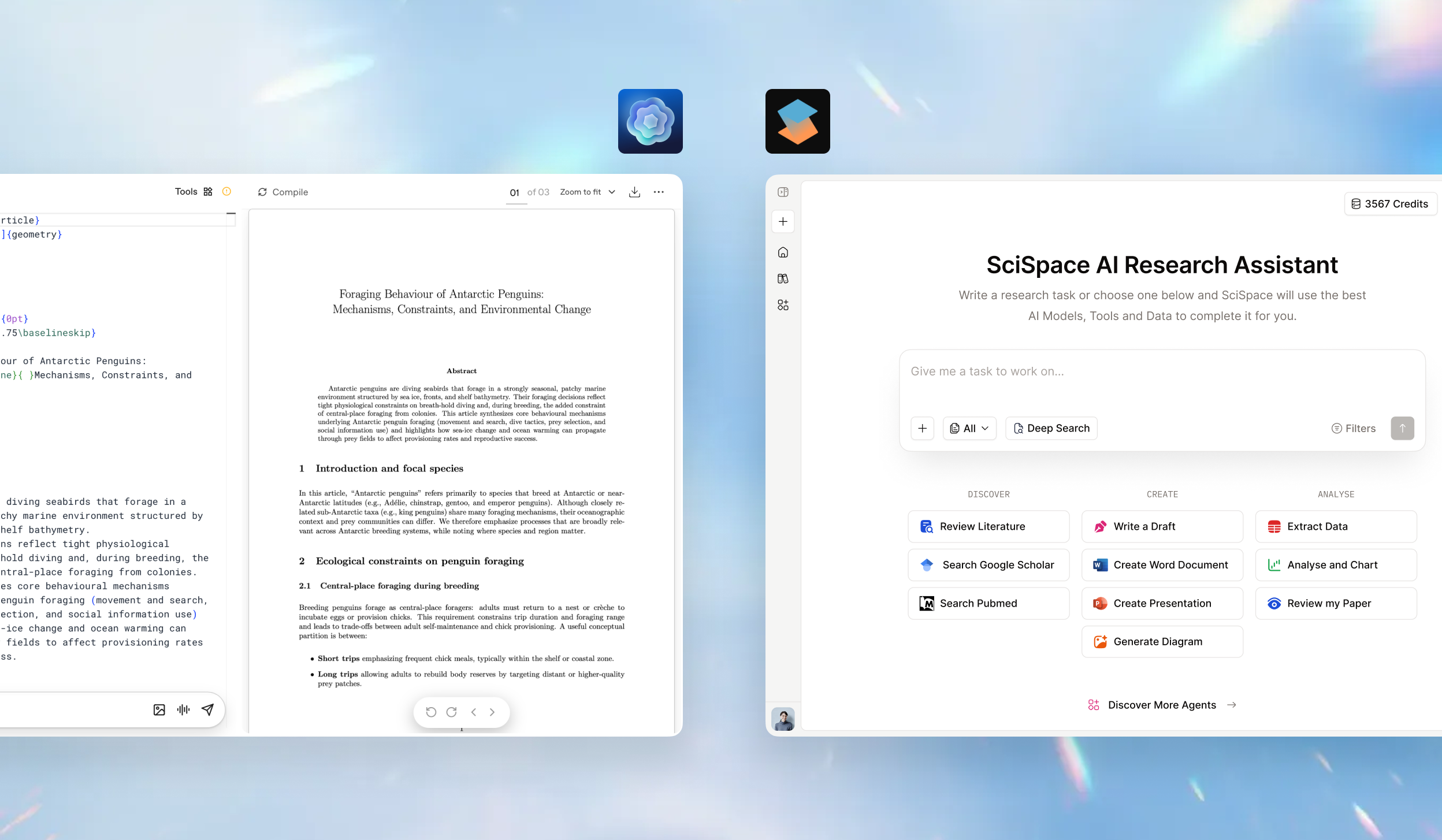
SciSpace lets you ask questions of any uploaded research PDF.

Whether you are creating lecture notes or a journal papers, SciSpace generates AI graphics for you.

SciSpace works with any file you throw at it. You can edit docx, pptx, pdf, markdown and more.

Instead of keyword searches, SciSpace employs semantic AI search to find relevant papers.
THE COMPARISON
Choosing the Right Alternative to OpenAI Prism
Why Researchers are Exploring Prism Alternatives
Traditional "Horizontal AI" like Prism often creates a "fragmentation gap." Researchers must still move between a reference manager, a PDF reader, a separate database (like PubMed), and their editor. SciSpace eliminates this friction by unifying these steps into a single, context-aware sequence.
The Topical Authority Gap: "Thinking" vs. "Knowing"
The Prism Approach: GPT-5.2 uses advanced reasoning to help you structure a paper and solve equations.
The SciSpace Advantage: SciSpace agents don't just reason; they verify. By grounding every output in a repository of 280 million papers, SciSpace ensures that your citations are not only real but are the most relevant in your specific niche.
Specialized Agents for Vertical Research Needs
Topical authority is built through specialization. SciSpace offers targeted agents that OpenAI Prism does not currently provide:
Systematic Literature Review (SLR) Agent: Automates exhaustive surveys with audit-ready logs, reducing weeks of search time to minutes.
BioMed Agent: Specialized for clinical genomics, variant interpretation, and drug discovery; grounded in 20+ curated databases like ClinVar and gnomAD.
Grant Writer Agent: Assembles complete grant packages aligned specifically to the solicitation guidelines of agencies like NIH or NSF.
Ablation Table Builder: Instantly transforms raw experiment logs into publication-quality LaTeX tables with statistical significance markers.
Why choose SciSpace?
For researchers who prefer a research-first workflow but still need LaTeX outputs, SciSpace is the best alternative. While it doesn't offer a real-time collaborative code editor like Prism, it provides powerful LaTeX Export and Equation-to-LaTeX tools that bridge the gap between discovery and final typesetting.